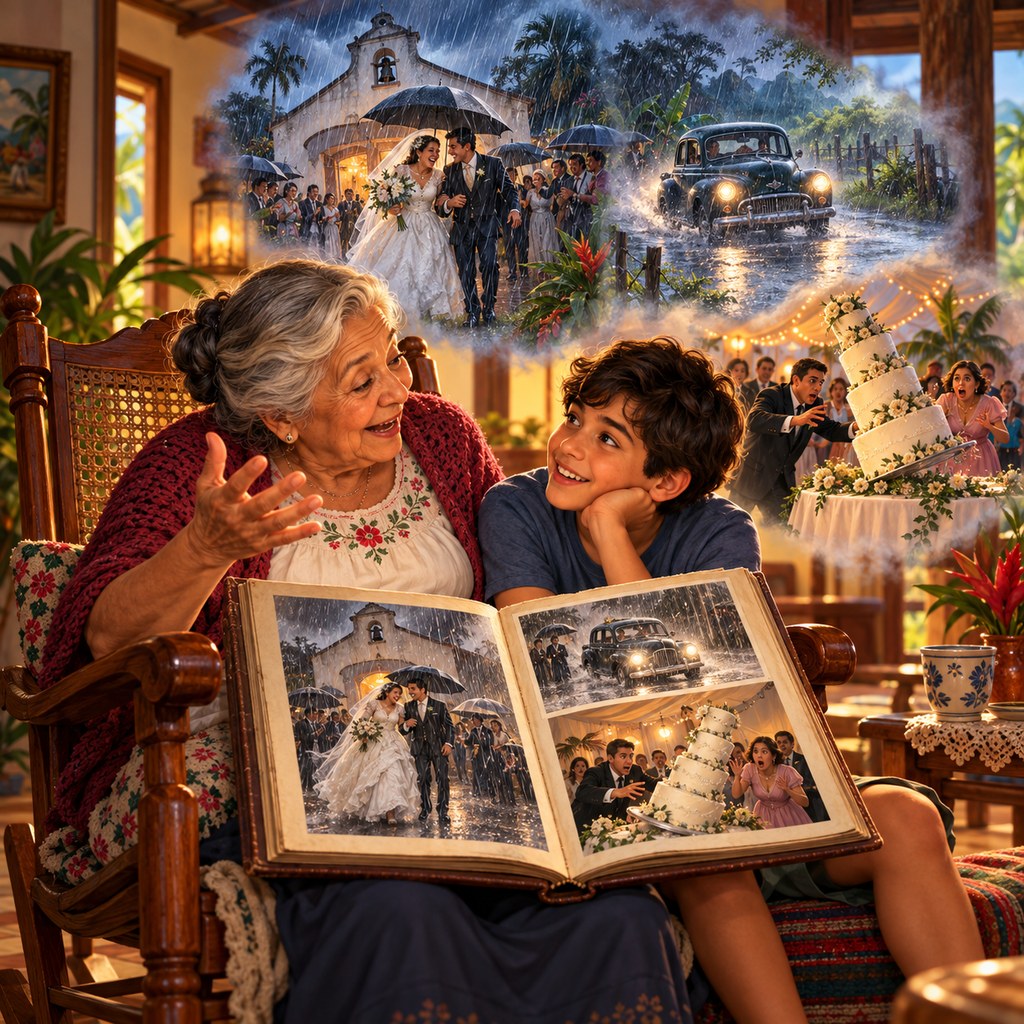
Tu abuela cuenta, cada vez que hay visita, cómo fue el día en que se casó: llovió toda la mañana, el carro llegó tarde a la iglesia y el pastel casi se cae. Todos ya la conocen de memoria, pero nadie se cansa. Esa historia es uno de esos eventos inolvidables. En inglés se cuenta con tres ingredientes: el pasado simple, preguntas para pedir datos y palabras que ordenan lo que pasó.
Definición
Un event es algo que sucede en un lugar y en un momento concretos. Un evento unforgettable (inolvidable) es uno que recuerdas durante años. Se cuenta casi siempre en pasado simple, con conectores como first, then, after that, later, finally.
Tres tipos de eventos#
| Tipo | Ejemplos |
|---|---|
| family events (de la familia) | a wedding (boda), a birthday party (fiesta de cumpleaños), a graduation (graduación), the birth of a baby (nacimiento de un bebé), a family trip (viaje familiar) |
| national events (de Costa Rica) | the abolition of the army in 1948, Claudia Poll’s gold medal in 1996, Costa Rica in the quarterfinals of the 2014 World Cup |
| world events (del mundo) | the Olympic Games, the Moon landing in 1969, the COVID-19 pandemic in 2020 |
Algunos datos para que sepas de qué estás hablando. En 1948, el presidente de la Junta Fundadora, José Figueres Ferrer, abolió el ejército en Costa Rica. En 1996, en los Juegos Olímpicos de Atlanta, la nadadora Claudia Poll ganó la medalla de oro en los 200 metros libres, la primera de oro para el país. En 2014, la Selección llegó a cuartos de final del Mundial de Brasil y quedó fuera contra Países Bajos en una definición por penales. Y en julio de 1969 los astronautas del Apolo 11 caminaron en la Luna.
Contar un evento en pasado#
Para contar lo que pasó se usa el pasado simple. Hay dos grupos de verbos.
Verbos regulares: -ed#
Se agrega -ed al verbo base: celebrate → celebrated, walk → walked, visit → visited, play → played, cry → cried, stop → stopped.
Verbos irregulares#
No siguen la regla y hay que memorizarlos. Los que más aparecen al contar eventos:
| Presente | Pasado | Significado |
|---|---|---|
| go | went | ir |
| come | came | venir |
| see | saw | ver |
| eat | ate | comer |
| give | gave | dar |
| win | won | ganar |
| make | made | hacer |
| have | had | tener |
| take | took | tomar, llevar |
| be | was / were | ser, estar |
El verbo to be en pasado tiene dos formas: was (I, he, she, it) y were (you, we, they). My cousin’s wedding was in December. There were many people.
Para negar y preguntar con verbos que no son to be, el auxiliar es did, y el verbo vuelve a su forma base:
- Afirmativa: We went to the beach.
- Negativa: We didn’t go to the beach.
- Pregunta: Did you go to the beach? — Yes, I did. / No, I didn’t.
El error clásico: Did you went? Debe ser Did you go? Con did el verbo ya no se pone en pasado. Did lo carga.
Preguntar y dar información sobre un evento#
Para pedirle datos a alguien sobre un evento, estas son las preguntas básicas:
| Pregunta | Qué averigua |
|---|---|
| What was the event? | qué fue |
| When did it happen? | cuándo |
| Where was it? | dónde |
| Who was there? | quién estuvo |
| How many people came? | cuántos |
| What did you do? | qué hiciste |
| Why was it special? | por qué fue especial |
| How did you feel? | cómo te sentiste |
Y las respuestas siguen un orden natural:
- It was my sister’s graduation.
- It happened on November 20. (on con fechas exactas, in con meses y años, at con horas)
- It was in the school gym in Heredia.
- My parents, my grandparents and many friends were there.
- It was special because she was the first person in our family to finish high school.
Con who como sujeto no se usa did: Who won the medal? (no Who did win). Con who como objeto, sí: Who did you see?
Los conectores de secuencia en pasado#
Para que el relato tenga orden se usan palabras que marcan el momento. Son las mismas que en el presente, pero aquí se acompañan de verbos en pasado.
| Conector | Ejemplo |
|---|---|
| First, | First, we arrived at the church. |
| Then, / Next, | Then, my cousin walked in with her father. |
| After that, | After that, we went to the party. |
| Later, | Later, the band played. |
| Finally, | Finally, everybody danced until midnight. |
Otros conectores útiles: before (antes de), after (después de), when (cuando), at the end (al final). Before the party started, we decorated the house. After the party ended, we cleaned up.
Dos relatos completos#
Un evento de la familia#
«Last year my sister graduated from high school. It was an unforgettable day. First, the whole family woke up early and put on nice clothes. Then, we went to the school gym in Heredia. The ceremony started at ten o’clock. After that, the principal called each student’s name and my sister walked to the stage. My mother cried. Finally, we ate lunch at my grandmother’s house and took many photos. It was special because she was the first person in our family to finish high school.»
Un evento nacional#
«In 1996, Claudia Poll won a gold medal at the Olympic Games in Atlanta. She swam the 200-meter freestyle. Many Costa Ricans watched the race on television. After she won, people celebrated in the streets. It was an unforgettable moment for the country.»
Observa el patrón en ambos: se dice qué pasó, cuándo y dónde, después se narran los pasos en orden y se cierra con una frase que explica por qué se recuerda.
Entrevista corta#
Mateo: What event do you remember most from your childhood?
Abuela: My first trip to the beach.
Mateo: When was it?
Abuela: It was in 1975. I was ten years old.
Mateo: Where did you go?
Abuela: We went to Puntarenas by train.
Mateo: Who went with you?
Abuela: My parents and my four brothers.
Mateo: Why was it unforgettable?
Abuela: Because it was the first time I saw the ocean.
Traducción: Mateo le pregunta a su abuela cuál es el evento que más recuerda; ella responde que su primer viaje a la playa, en 1975, a los diez años, hacia Puntarenas en tren, con sus padres y sus cuatro hermanos; fue inolvidable porque vio el mar por primera vez.
Errores frecuentes#
- Poner el verbo en pasado después de did. Did you went está mal. Es Did you go?
- Decir «I was went». Los dos auxiliares no se mezclan: I went.
- Añadir -ed a un irregular. goed, eated, winned no existen. Son went, ate, won.
- Confundir was y were. We was there debe ser We were there.
- Usar on con un año. Se dice in 1948, no on 1948.
- Escribir una lista de hechos sin orden. Un buen relato usa conectores; si todo es «and then, and then», se vuelve monótono. Alterna first, after that, later, finally.
- Mezclar presente y pasado en el mismo relato. Si empiezas en pasado, sigue en pasado.
Cómo practicar#
Pídele a alguien mayor de tu familia que te cuente un evento que recuerde bien y escribe, en inglés, cinco oraciones sobre él: qué fue, cuándo y dónde, quién estuvo, tres pasos con conectores y por qué fue especial. Después, haz lo mismo con un hecho de la historia de Costa Rica que hayas visto en Estudios Sociales. Si te trabas con un verbo irregular, anótalo en una tarjeta y repásalo durante la semana. Con diez verbos irregulares seguros, puedes narrar casi cualquier historia.
Ponte a prueba#
Convierte a pasado: «We go to my grandmother’s house for Christmas».#
«We went to my grandmother’s house for Christmas». Go es irregular y su pasado es went.
Corrige: «Did she wins the medal?»#
Debe ser «Did she win the medal?». Con did el verbo principal vuelve a la forma base; did ya lleva el pasado.
Escribe tres preguntas para pedirle información a alguien sobre su graduación.#
Por ejemplo: «When was your graduation?», «Where was it?» y «Who was there?». Con to be en pasado no se usa did.
Ordena con conectores: ‘ate lunch’, ‘arrived at the church’, ‘took photos’.#
«First, we arrived at the church. Then, we ate lunch. Finally, we took photos». Cada conector abre un paso y el verbo va en pasado.
¿Por qué «Costa Rica abolished the army in 1948» usa abolished y no abolish?#
Porque habla de un hecho terminado en el pasado y abolish es regular: se forma el pasado simple con -ed.
Fuentes#
También en Inglés 8ºOctavo año